For women
As everyone knows, you can’t escape the subject of age when it comes to understanding female fertility
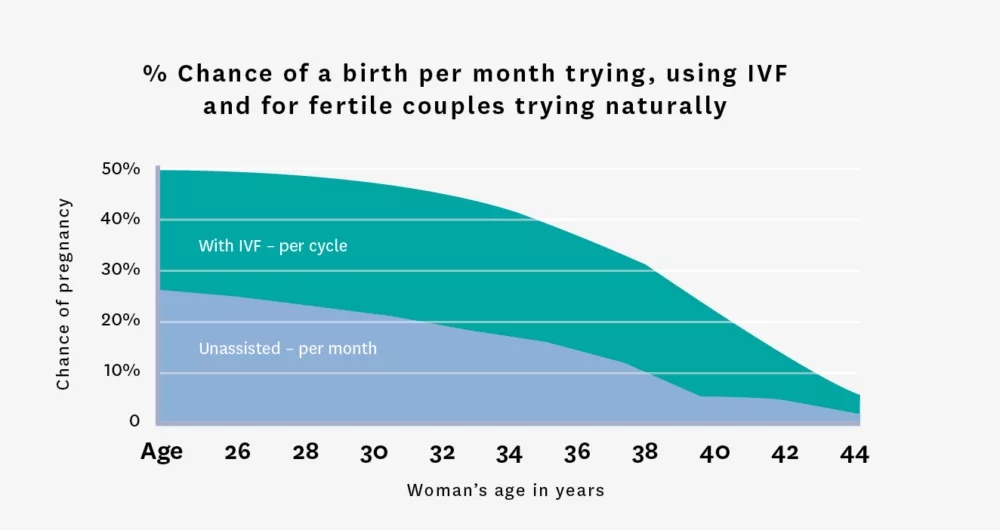
The chance of pregnancy falls as a woman gets older, and the risk of miscarriage and abnormalities increases, even for people with no fertility problems. If you are having trouble becoming pregnant, the sooner you seek help, the better your chance of having a baby.
Egg quantity: how many eggs are left?
Women are born with ovaries containing over a million eggs. These eggs die over time through a natural process, leaving an average of 400,000 at puberty and fewer than 1,000 at menopause. Not all women lose eggs at the same rate. While many women remain fertile into their late 30s, some experience a more rapid decline and may lose fertility earlier than expected.
The term ovarian reserve refers to the number of eggs remaining in the ovaries.
Anti-Mullerian Hormone (AMH) testing
Your GP can request an AMH test, however we recommend an appointment with a fertility specialist to analyse the results, and to explain what they mean for you.
- It is a single blood test that can be done at any time during the menstrual cycle.
- It can help predict how many eggs you are likely to obtain in an IVF cycle.
- It may also identify women who may undergo early menopause, and therefore who may lose their fertility earlier than average.
- Your doctor or nurse will give you a separate blood form for the test and tell you where you can have your test done. The result is usually available a week or so after the blood has been taken. Your doctor will tell you the result in person, by telephone or by sending you a letter.
- The interpretation of the AMH result will depend on your medical history, your family’s fertility history, lifestyle and other investigations into your fertility.
- In some areas of New Zealand the AMH test is not publicly-funded. The cost is typically $85 to $110 depending on the lab.
Interpreting AMH
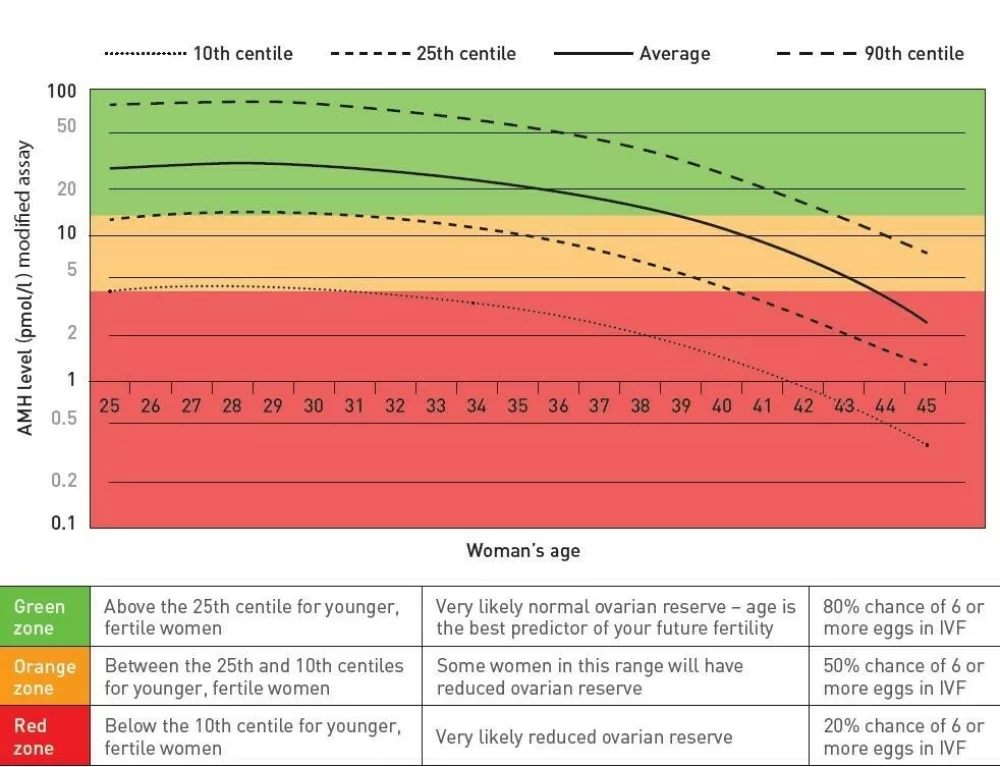
Like most fertility tests, an AMH test does not give a 'black and white' answer. We plot the AMH result on a graph, (see below), that shows the 10th, 25th, 50th and 75th centiles for AMH for women attending a fertility clinic. This lets you compare your results with women of a similar age and helps predict how your AMH level may change over the years. We have shaded areas of the graph green, orange and red to represent the average impact of your AMH level.

Egg quality: why age matters
While AMH tells us about the number of eggs remaining, it does not tell us about the health of those eggs.
Egg quality is influenced predominantly by age.
Each egg contains chromosomes that must divide accurately when fertilisation occurs. As women age, chromosome separation becomes less reliable, increasing the chance that an egg contains too many or too few chromosomes. This is called aneuploidy.
Many women are surprised to learn that egg quality can decline even when AMH remains normal. This explains why:
- a 32-year-old woman with a low AMH may still have a good chance of pregnancy.
- a 42-year-old woman with a normal AMH may still face significant fertility challenges related to egg quality.
Age affects both quantity and quality, but quality is often the more important factor when it comes to achieving a healthy pregnancy.
Aneuploidy, miscarriage and fertility
As egg quality declines, chromosome abnormalities become more common.
Embryos with chromosome abnormalities are less likely to:
- implant successfully
- continue to develop normally
- result in the birth of a healthy baby.
This is why increasing maternal age is associated with:
- lower natural fertility
- lower IVF success rates
- higher miscarriage rates
- increased risk of certain chromosomal conditions such as Downs syndrome.
The majority of first-trimester miscarriages are thought to result from chromosomal abnormalities in the embryo.
Is age affecting your fertility?
For women, fertility begins to decline at around the age of 30, with this becoming more marked after 35, with an even steeper decline after 40. Fertility in men does also decreases, but much more slowly and less noticeably. This is why the option of egg freezing is attractive for those who are keen to have a family, but are not yet ready.
As a rough guideline, you may want to seek advice if:
- you are under 35 and have been trying to conceive for 6 months or more without success
- you are 35 or older and have been trying for 12 months or more without success
- you are over 40.
For most women, age best predicts the chance of conception each month. However, despite having regular menstrual cycles and normal periods, about 10% of women lose their fertility sooner than expected. These women should think about having a family in their 20’s or very early 30’s.
For some women, the effect of age kicks in early.
- About 10% of women experience menopause 5 years earlier than average – around the age of 45 instead of 50. Their fertility will fall 5 years earlier than average.
- About 1% of women go through menopause 10 years earlier than average, around the age of 35. Their fertility will fall 10 years earlier than average.
If you are having concerns, we suggest a chat with one of our experienced fertility nurses, free of charge. You will be able to discuss your individual situation and they will guide you as to next steps.
Alternatively, make an appointment to see one of our fertility specialists who will be able to assess your fertility and prepare a plan for you.

For men
While there’s no male equivalent to menopause, and the age of the mother is more important where fertility is concerned, the number of sperm made each day, and their quality, do fall with a man’s age.
Pregnancies from older men show higher incidences of some types of abnormalities among children – such as schizophrenia and autism. The total risk of a child having a serious birth defect, (from the biological father, the mother, or newly arising in the child), increases from an average of 20 per 1000 children for men aged 20; to 26 per 1000 children for men aged 50.
A man’s age does not seem to affect the chance of success in fertility treatments such as IVF – at least up to the age of 50.
When to seek help
Knowing when to seek help can be confusing
Should you keep trying for a bit longer, or do you need to book an appointment to talk it through?
You can try our Biological Clock which estimates the rate of natural conception per month of someone having no fertility issues.
Talk to one of our experienced fertility nurses in a free, no obligation 20 minute telephone chat. Book now.
FAQs
What should I ask the doctor at my first appointment?
Here is a list of possible questions you may want to ask at your first appointment:
- What lifestyle changes can I make to boost my chance of success (eg, diet, exercise, stopping smoking, etc)? How will these help?
- Who will be the team caring for me? Who should I contact if I have a question?
How can I get an AMH test?
Your doctor or nurse will give you a separate blood form for the test and tell you where you can have your test done. The result is usually available a week or so after the blood has been taken. Your doctor will tell you the result in person, by telephone or by sending you a letter. The interpretation of the AMH result will depend on your medical history, your family’s fertility history, lifestyle, and other investigations to your fertility.
How much does an AMH test cost?
In most areas of New Zealand, the AMH test Is not publicly funded. Unless you live in one of those areas where the test is publicly funded and you meet the criteria, Fertility Associates will send you an invoice for it. This may arrive a few weeks after you have had your test because the blood collection labs only bill us once a month. The cost is typically $85 to $110* depending on the lab.
Fertility Associates does pay for an AMH test immediately before publicly funded treatment to help decide the best drug dose.
How do i interpret AMH results?
Like most fertility tests, an AMH test does not give a black and white answer. We plot the AMH result on a graph (see below) that shows the 10th, 25th, 50th and 75th centiles for AMH for women attending a fertility clinic. This lets you compare your results with women of a similar age and helps predict how your AMH level may change over the years. We have shaded areas of the graph green, orange and red to represent the average impact of your AMH level.
Download AMH leaflet PDF for more information.
What if I have no sperm?
In such instances, we would perform an examination and run some blood and genetic tests. Where possible, we could attempt to retrieve the sperm directly from the testicles. This sperm would then be used to fertilise any eggs collected from an IVF cycle.